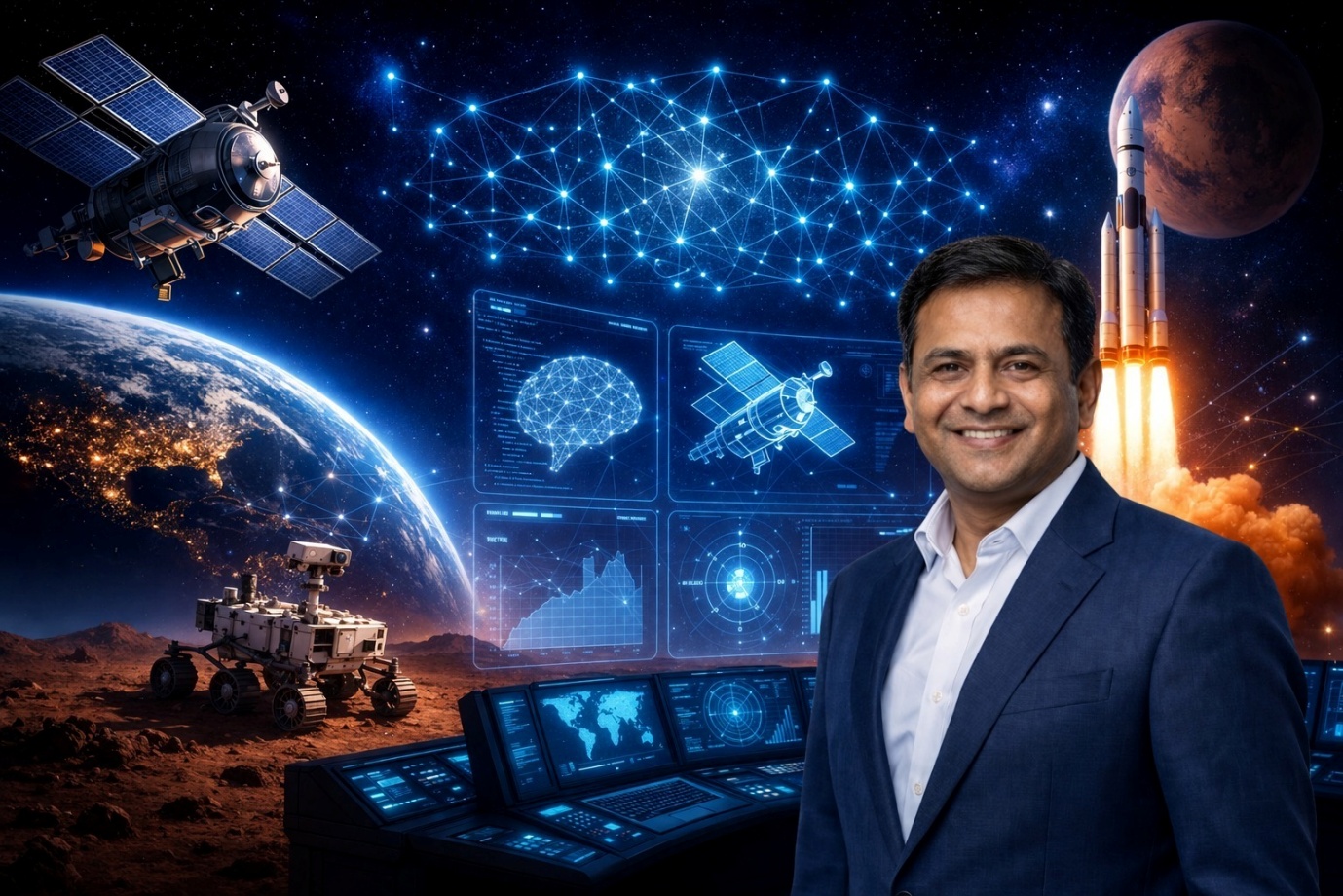
As space missions become more ambitious, artificial intelligence is emerging as one of the most critical technologies shaping the future of exploration. Industry observers such as Brijesh Goel have increasingly drawn attention to how AI is helping space agencies and private players overcome the challenges of distance, time delay, equipment reliability, and large-scale data processing.
From autonomous spacecraft systems to predictive maintenance and satellite optimisation, AI is now deeply integrated into modern space engineering.
Enabling autonomy in deep-space missions
One of the most significant applications of AI in space exploration is spacecraft autonomy. Missions operating millions of kilometres away from Earth cannot rely entirely on real-time human intervention because communication delays can slow critical decision-making.
AI-powered systems allow spacecraft and rovers to analyse their surroundings, make route adjustments, and respond to unexpected conditions independently. Missions led by NASA have already demonstrated this through Mars rover navigation, where intelligent systems help vehicles detect hazards, optimise paths, and maximise mission efficiency on the surface of Mars.
This growing autonomy is expected to become even more important as future missions travel farther into deep space.
Managing massive volumes of space data
Modern astronomy and Earth observation missions generate enormous amounts of information through telescopes, satellites, and interplanetary sensors. Processing such large datasets manually is increasingly impractical.
AI and machine learning are helping scientists identify anomalies, classify celestial objects, and accelerate discoveries such as exoplanet detection and galaxy mapping. Private Earth-imaging companies like Planet Labs and Satellogic are also using AI to process satellite imagery and deliver near real-time intelligence for Earth-based applications.
This data-driven capability is becoming central to both scientific exploration and commercial satellite services.
Improving mission safety through predictive maintenance
Spacecraft operate in highly hostile environments where even minor technical failures can jeopardise years of planning and billions in investment. AI-driven predictive maintenance systems are increasingly being used to monitor spacecraft health, assess component behaviour, and identify early warning signs before failures occur.
This approach supports mission longevity while reducing operational risks. Private launch and spacecraft companies such as Rocket Lab are among the organisations integrating intelligent systems into launch monitoring and spacecraft performance management.
The result is greater reliability across both launch and orbital operations.
Transforming satellite communications and infrastructure
AI is also reshaping satellite communications, positioning systems, and space traffic management. Intelligent satellite constellations can dynamically optimise bandwidth allocation, improve weather forecasting models, and strengthen remote sensing capabilities.
Companies such as SpaceX, through Starlink, and Blue Origin are helping expand satellite-driven infrastructure where AI-based optimisation plays an increasing role in network efficiency and orbital coordination.
These developments are enhancing global connectivity while supporting the next generation of space-based services.
AI’s future in lunar and Mars missions
Looking ahead, AI is expected to play a foundational role in missions beyond Earth orbit. Programs such as Artemis II represent the next step in human lunar exploration, with long-term ambitions extending toward human missions to Mars.
AI applications in these missions are likely to include navigation support, habitat systems management, autonomous diagnostics, robotic assistance, and mission planning. Intelligent systems will be essential not only for spacecraft operations but also for sustaining human presence in hostile extraterrestrial environments.
Conclusion
The integration of AI into space technology is redefining how exploration missions are designed, managed, and executed. Through autonomous systems, advanced data processing, predictive maintenance, and smarter satellite networks, AI is making missions faster, safer, and more efficient.
As organisations across public and private space sectors continue investing in intelligent systems, AI is set to remain a defining force in the next era of lunar, Martian, and deep-space exploration.